Case study6 min readNovember 2, 2026
Scott Fraser Collection: three months of try-on on made-to-order menswear.
A UK menswear label that makes every suit and trouser to order put Garu on its Shopify store in July 2026. In the first three weeks of order tracking, shoppers who used Garu spent 56% more per order than everyone else. Three months in, they have tried on 2,832 pieces.
Scott Fraser Collection is a UK menswear label that makes its trousers, suits and knitwear to order and sells mostly online. Every piece is cut after the customer pays, so a wrong decision is expensive for both sides. Garu went live on the store on 27 July 2026. This is everything that has happened since, through 2 November.
The problem: a made-to-order purchase with no fitting room
A tailored suit at several hundred pounds is a considered buy. In a shop, the customer would try on a sample, look at the cut on their own body, and decide. Online, they get a model photo and a fabric swatch. The question that stalls the purchase is the simplest one: how will this look on me? For made-to-order clothing there is no easy return to fall back on, so a shopper who cannot answer it either guesses or leaves.
What Garu does on the store
A Try it on button sits on trousers, suits and knitwear. The shopper uploads one photo and gets the garment rendered on their own body, front and back, in a few seconds. Garu is synced to the store’s made-to-order customiser, so a shopper can try a piece on and carry straight on to configuring it. There was no theme rebuild: Garu installs as a Shopify app embed.
What shoppers did with it
- 2,832 pieces tried on between 27 July and 2 November, across 65 products.
- About 500 shoppers used it, in more than 800 visits.
- About 3.5 pieces per visit. Shoppers use Garu to compare. They try a wide-leg trouser, then a straight one, then the suit, before they decide.
The orders
Garu started linking orders to try-on sessions on 16 September.
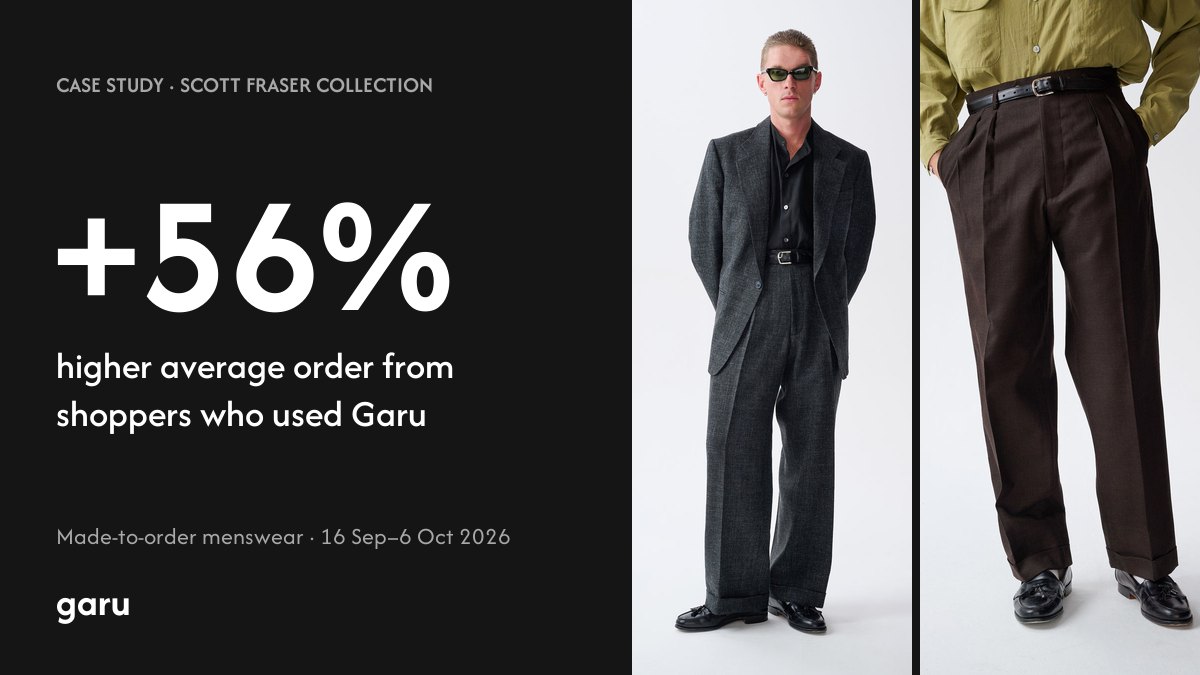
- +56% average order in the first three weeks. From 16 September to 6 October, shoppers who used Garu first spent 56% more per order than the store’s other shoppers. 9 of their 11 orders included a piece they had tried on.
- +32% across every order since. Over all linked orders to 2 November, the gap is 32%, against about 400 orders from other shoppers.
- 20 of 24 orders from those shoppers included a piece they had tried on first.
- 0 refunded. None of the 24 orders has been refunded.
The whole store, before and after
Looking past the linked orders to every sale on the store: in the 13 weeks since Garu went live, weekly sales are 11% higher than in the seven weeks before it, and the average order across the whole store rose from £318 to £388. The same weeks in 2025 went the other way, down 4%. A one-off sale week in June is left out of both years, and the autumn collection launched in late September, so read this as a direction rather than a measured effect.
How we counted, and what it does not show
We match each Garu session to Shopify orders through the cart and through checkout tracking. Each shopper counts once, so one keen customer cannot inflate the result. One browser placed 21 linked orders across many sessions, which is what orders keyed in by the store’s own team look like, so it is left out, along with its 39 try-ons.
This is an observational comparison, not a controlled test. Shoppers who choose to try a suit on may be keener buyers to begin with, and 24 orders is still a small sample. The early weeks show the biggest gap, +56%; across every order to date it is +32%. We give both, with their dates, and we no longer use the +71% we published in October, which included two orders from the store team’s browser. The next step is a holdout test: hide Garu from a random share of shoppers and measure the difference directly.
Why it matters for made-to-order brands
A made-to-order label cannot lean on free returns to make shoppers comfortable. It has to remove the doubt before the order. Seeing the cut on your own body is the closest thing to a fitting room a web page can offer, and on this store the shoppers who used it bought more and kept what they bought.
All of our case-study numbers are on the case studies page, and DEWEY’s story shows the same thing from the sizing side.
Questions merchants ask
What does Garu do on Scott Fraser Collection?
Shoppers upload one photo and see trousers, suits and knitwear rendered on themselves, front and back, before they order. Garu is synced to the store’s made-to-order customiser, so the piece a shopper tries on is the piece they go on to configure.
How were Garu orders counted?
An order counts as a Garu order when it is linked to a shopper’s Garu session, through the cart or through Shopify checkout tracking. Linking began on 16 September 2026, so every order since then is included. Each shopper counts once. One browser that placed 21 orders across many sessions, the pattern of orders entered by the store’s own team, is left out.
Does this prove Garu caused the higher order value?
No. It shows what shoppers who used Garu did, compared with shoppers who did not, over the same weeks. Shoppers who choose to try things on may already be keener buyers. A controlled test that hides Garu from a random share of shoppers is the next step.
Why is the figure lower than the +71% you published in October?
The October figure included two orders that we have since traced to the store team’s own browser. With those removed, the first three weeks show +56%, and every order to date shows +32%. We publish both, with their dates.