Case study5 min readNovember 2, 2026
DEWEY: sizing petite jeans without a fitting room.
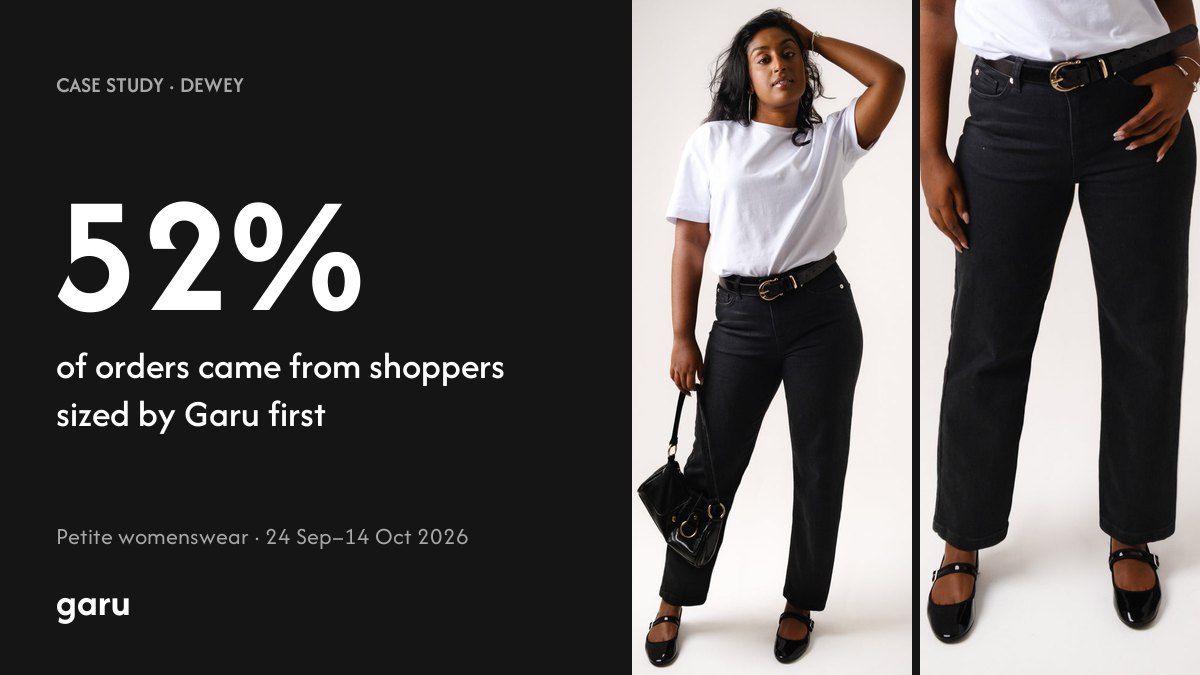
DEWEY makes clothes for very short women, and its jeans live or die on the inseam. Over three weeks in autumn 2026, half of all DEWEY orders came from shoppers who got their size from Garu first, and their orders were 38% larger.
DEWEY makes clothing for very short women. Its jeans lead the range, which means one measurement decides almost every sale: the inseam. A petite shopper has learned the hard way that standard sizing does not describe her, so she arrives on a product page expecting to be wrong. DEWEY put Garu on its Shopify store on 4 September 2026. These are the numbers through 2 November.
The problem: petite shoppers have stopped trusting size charts
A size chart assumes the shopper knows her measurements and that the brand’s numbers mean what she thinks. For petite women both assumptions fail more often than not, and the cost lands on the brand as returns and abandoned carts. The question on the page is not “do I like these jeans?” but “will they be the right length on me?”
What Garu does on the store
DEWEY runs the standard Garu app, with no custom build. Shoppers answer a few quick questions and get a size for the garment they are looking at, matched to DEWEY’s own chart, with a note on how it will fit. Try-on is there too, but on this store sizing does the work.
What shoppers did with it
- 749 shoppers sized since go-live, with 1,410 sizes given across 21 products.
- 98% got a size. Of the shoppers who opened Garu, almost all finished and got an answer.
The orders
Garu began linking orders to sizing sessions on 15 September.
- Half of all orders. From 24 September to 14 October, 14 of the store’s 27 orders came from shoppers who got their Garu size first.
- 38% larger orders from those shoppers than from everyone else over the same three weeks.
- 11 of those 14 buyers paid within 20 minutes of getting their size.
- Since go-live: 21 of 57 orders, more than a third of the store’s sales, came from sized shoppers, and 16 of those 21 paid within 20 minutes.
The speed is the telling part. A shopper who gets a size she trusts does not go and measure herself, does not open three tabs, and does not leave to think about it. She buys.
How we counted, and what it does not show
We match each Garu session to Shopify orders through the cart and through checkout tracking, and each shopper counts once. The comparison is between shoppers who used Garu and those who did not, over the same weeks, so it shows what sized shoppers did rather than proving Garu caused it. Shoppers who look for sizing help may already be close to buying. One of the 21 Garu orders has been refunded so far. A holdout test, with Garu hidden from a random share of shoppers, is the next step.
Why it matters for petite and hard-to-fit brands
For a brand whose whole reason to exist is fit, the size answer is the product page. Putting it in front of the shopper, matched to the brand’s own chart, turns the most anxious moment of the purchase into the quickest one.
All of our case-study numbers are on the case studies page, alongside Scott Fraser Collection, where try-on does the same job for made-to-order menswear.
Questions merchants ask
What does Garu do on DEWEY?
DEWEY runs the standard Garu Shopify app with no custom build. Shoppers answer a few questions about their height, weight and fit, and Garu returns a size for the garment on the page, matched to DEWEY’s own chart.
How were Garu orders counted?
An order counts as a Garu order when it is linked to a shopper’s Garu session, through the cart or through Shopify checkout tracking. Every order since linking began on 15 September 2026 is counted, and each shopper counts once.
Does this prove Garu caused the sales?
No. It shows that shoppers who were sized went on to buy, and how quickly. Shoppers who look for a size guide may already be close to buying. A holdout test is the way to measure the lift directly.