Field guide7 min readSeptember 21, 2026
What happens to fit when the product page disappears?
Coach and Kate Spade now sell inside Gemini with no redirect, and OpenAI is piloting sponsored agents in ChatGPT. When the buy button leaves the product page, the size chart, the try-on and the reviews leave with it.
Two things happened on September 16. Tapestry made Coach and Kate Spade products purchasable inside the Gemini app and Google Search’s AI Mode: a Buy button appears in the conversation, checkout runs through Google Pay in a few taps, and the shopper never visits the brand’s site. The same day, OpenAI began piloting Sponsored Agents in ChatGPT, where tapping an ad opens a conversation with the advertiser’s own agent, with Wayfair, Best Buy, Lowe’s and others in the first group and a ChatGPT Ads app for US Shopify merchants.
Tapestry’s CEO, Joanne Crevoiserat, put it plainly: consumer behaviour is evolving and “now it’s happening inside a conversation with AI.” That is the right read. It is also worth noticing what the announcement does not mention. It says nothing about product pages, sizing, fit or returns.
The product page was doing a job
For apparel, the product page is where the shopper resolves doubt before paying. The size chart lives there. The reviews that say “runs small” live there. The try-on button, the fit note, the model’s measurements, the second angle, all of it sits between the photo and the cart. Roughly 42% of fashion returns are size-related, and that number is what it is with all of those signals in place.
Agentic checkout removes the page. It does not remove the doubt. A shopper who buys a pair of trousers from inside a chat, in three taps, with no size guidance, has the same body and the same uncertainty as before, and now no surface on which to resolve it. The return exposure does not go away. It moves to a place where nothing is measuring it.
Why it starts with handbags
Tapestry chose well. A Coach bag has no size. Kate Spade accessories mostly do not either. Agentic checkout works cleanly for products where the only question is “do I want it,” and that is where the first deployments will succeed. The trouble arrives when the same flow is pointed at a dress, which is inevitable, because the protocols are category-agnostic and the platforms want everything.
What a fit signal has to look like inside an agent
If the page is gone, the fit answer has to travel with the product. In practice that means three things a brand can prepare for now:
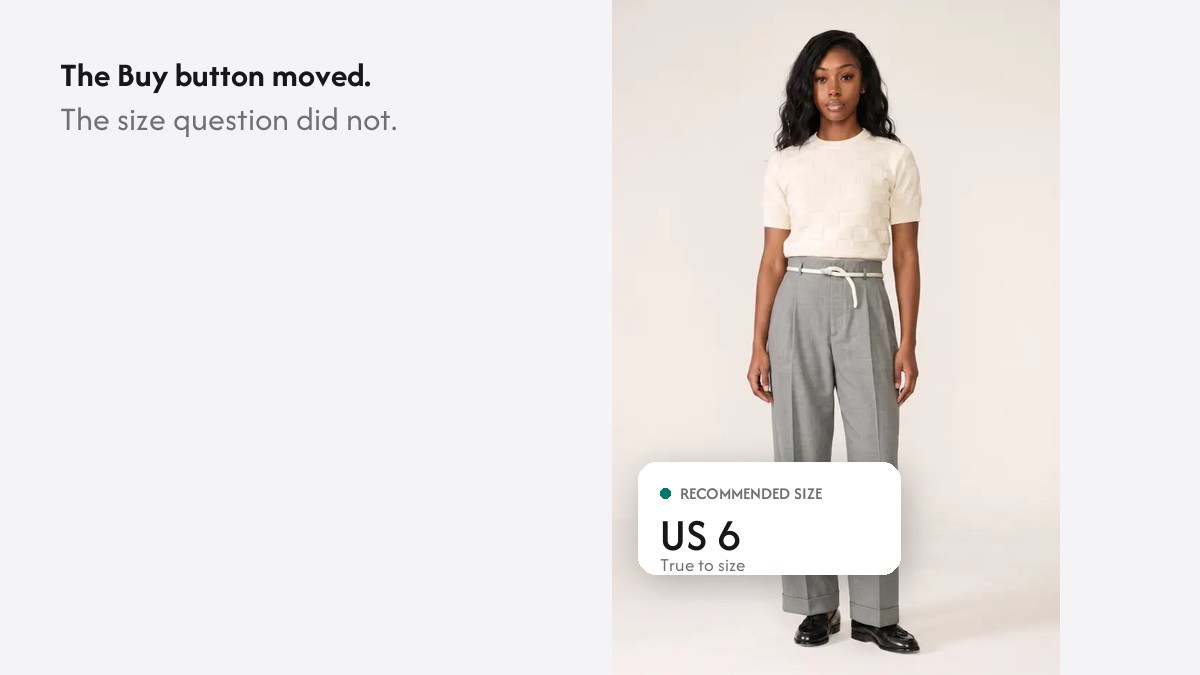
- A size the agent can state. Not a chart to interpret, a recommendation the agent can say back: “for you, this runs true to size, order a medium.” That requires a fit engine the agent can call, with the shopper’s measurements as input.
- A render the agent can show. A picture of the shopper wearing the garment is the one thing that resolves visual doubt without a page. It is also the thing a conversational interface is well suited to display.
- A returns reason the brand still sees. If the order was placed inside someone else’s agent, make sure the size-related return still reaches your data. Otherwise the cost is real and the diagnosis is gone.
What we are doing about it
Garu’s try-on and sizing already run as services behind the widget, not as page furniture. The render and the recommended size come from an API call that does not care where the checkout happens. As the agent protocols settle, that is the layer we intend to expose, so a brand selling inside Gemini or ChatGPT can hand the shopper a size and a picture before the Buy button, not a return afterwards.
Questions merchants ask
What is agentic checkout?
A purchase completed inside an AI assistant. The shopper finds the product in a conversation, a Buy button appears in the chat, and payment runs there, with no visit to the brand’s site. Tapestry’s Coach and Kate Spade launch in Gemini on 16 September 2026 works this way, using the Universal Commerce Protocol and Google Pay.
Why does agentic checkout raise return risk for clothing?
Roughly 42% of fashion returns are size-related, and that is with a product page full of fit signals. Buying a garment in three taps with no size guidance leaves the same doubt with no surface to resolve it, so the return exposure moves into the agent flow where nothing is measuring it.
Can a size recommendation work inside a chat?
Yes, if the fit engine runs as a service the agent can call with the shopper’s measurements and get back a size, a fit note and a render. Garu’s sizing and try-on already run that way behind the widget; the agent is another caller.