Field guide9 min readAugust 14, 2026
The best Shopify size finder apps, compared.
Size chart apps, quiz-based size finders, and garment-specific fit engines solve different problems at very different prices. Five Shopify options compared honestly.
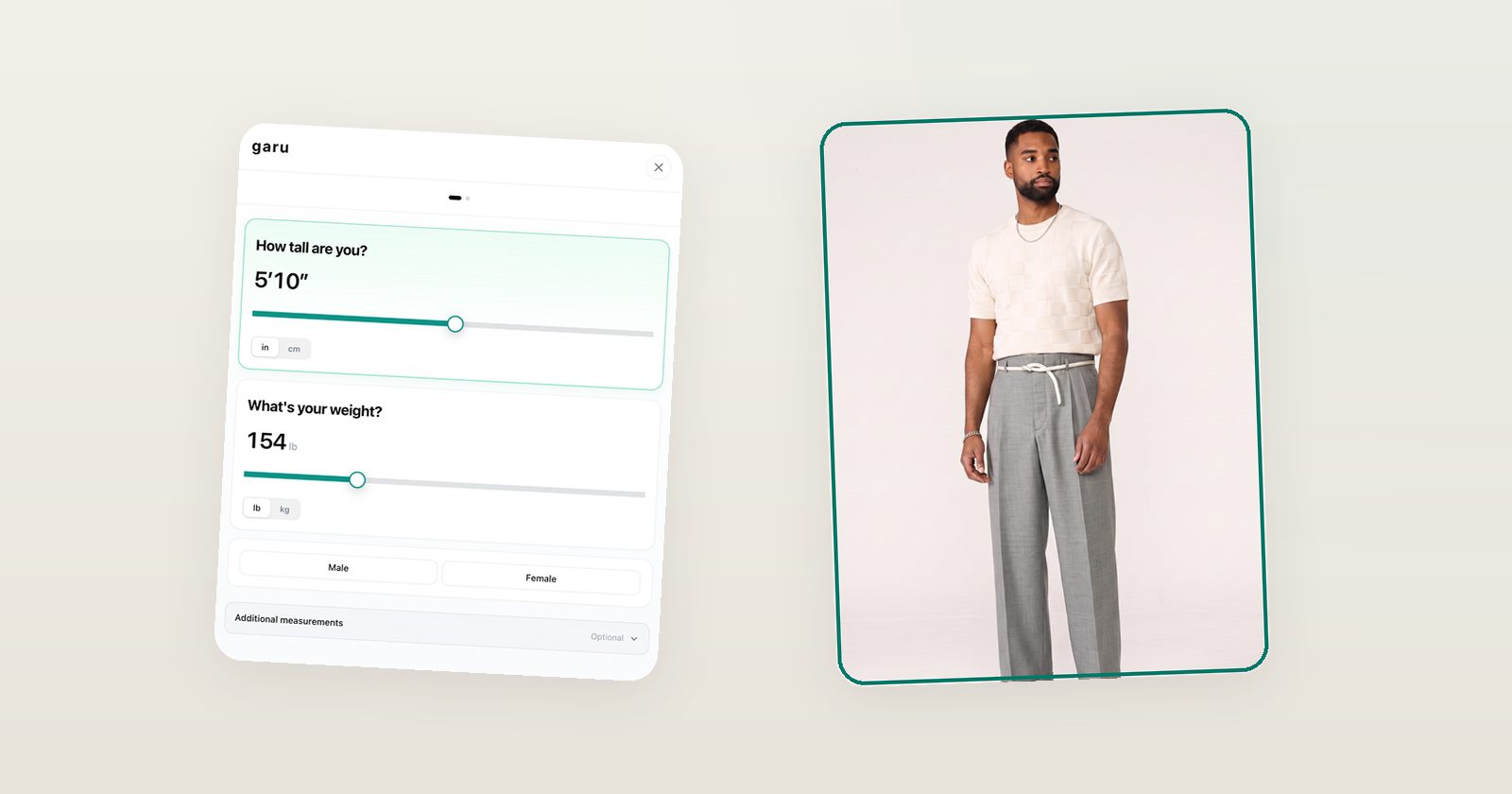
"Sizing app" covers three very different products, and most roundups blur them together. Size chart apps display measurements in a nicer table. Size finders ask the shopper questions and answer with a size. Fit engines recommend per garment, against your own chart, with a confidence score — and increasingly show the answer on the shopper's own body. They differ in price by an order of magnitude, because they do different amounts of the work.
Here are the five worth knowing on Shopify in 2026, compared with App Store numbers checked on August 14, 2026.
Disclosure: Garu makes one of the tools below. Competitor numbers come from their public App Store listings — check them yourself via the links.
The short version
| App | Generation | From | Rating |
|---|---|---|---|
| Garu | Fit engine + try-on | $199/mo (free tier) | 5.0 ★ (1), new in 2026 |
| Kiwi | Charts + recommender | Free / $7.99/mo | 4.8 ★ (1,100) |
| Smart Size Chart | Quiz finder | flat monthly | ~4.9 ★ |
| MP Size Chart | Charts + AI recs | budget | — |
| True Fit / Fit Analytics | Enterprise platform | custom | — |
1. Garu — the fit engine, with the fitting room attached
Garu treats sizing as a garment problem, not a body problem. A shopper gives height, weight and body shape — about thirty seconds, no tape measure — and Garu matches that profile against the specific product on the page and your own size chart, returning one size with a confidence score. When the honest answer is "between sizes," it says so rather than asserting a number. And because the same widget renders the piece on the shopper's body — at the recommended size, front and back — the recommendation isn't just asserted, it's shown.
- Reads your existing catalogue: your variants, your size labels (S/M/L, US 4, W32, EU 38), your per-collection charts — no measurement spreadsheet to key in first.
- Roll out gradually: enable one collection, check recommendations against your own returns data, widen from there.
- Merchant analytics: the funnel per product — sessions, try-ons, size recommendations, add-to-carts.
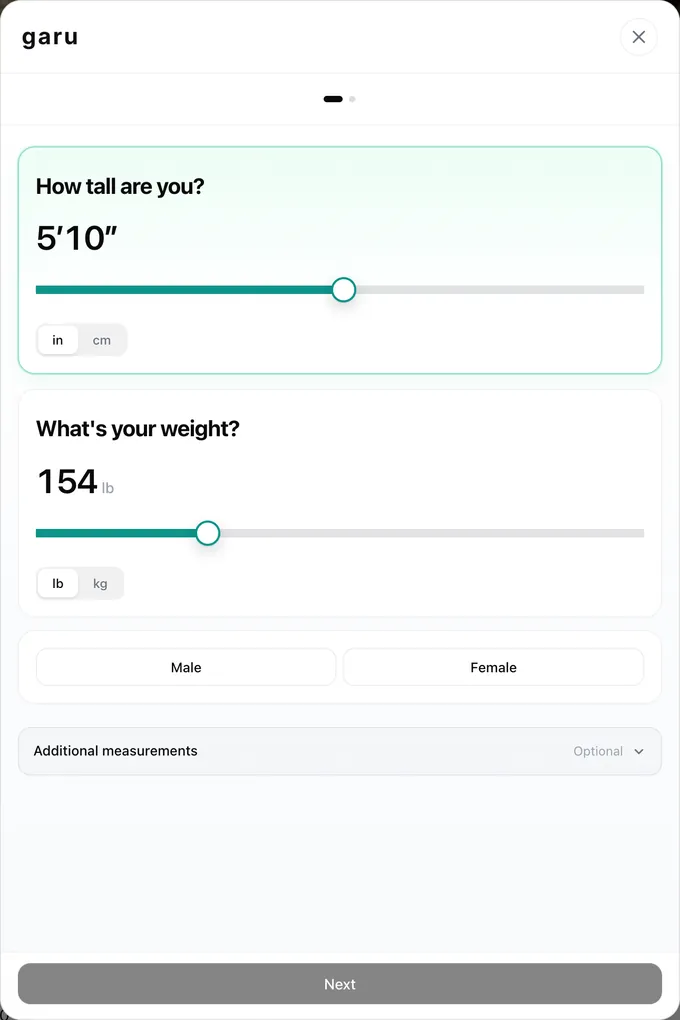
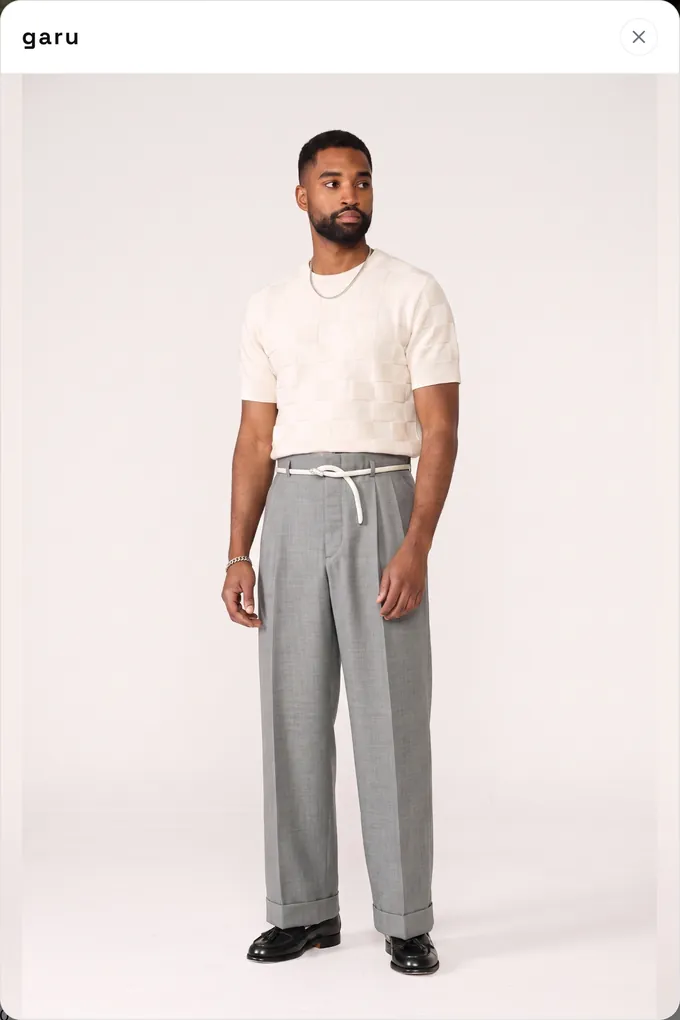
The honest cons: new (launched May 2026, one review) and priced as infrastructure — $199/month for 800 try-ons, $399/month for 2,500, with a 25-try-on free tier and a 14-day trial. If all you need is a nicer chart, this is more tool than the job requires — buy Kiwi.
Best for: apparel brands where size-driven returns are a P&L line item, not an annoyance.
2. Kiwi Size Chart & Recommender — the sensible default
Kiwi is the category incumbent for a reason: 4.8 stars across roughly 1,100 reviews, live since 2018, and priced from free (3 charts) through $7.99, $14.99 and $26.99 a month. You get clean, templated charts (22 templates, CSV and image import), automatic unit conversion by shopper location, multi-language support, and an AI-assisted size recommender on the upper tiers.
The trade-off: it's chart-first. The recommender helps, but the model is generic rather than garment-specific, and nothing is shown on the shopper's body. It organises the sizing information you already have; it doesn't produce new fit evidence.
Best for: almost every store's starting point — if you don't have tidy charts yet, fix that for $7.99 before considering anything else on this list.
3. Smart Size Chart & Fit Finder — the quiz approach
Smart Size Chart & Fit Finder represents the middle generation well: a "find my size" quiz that walks the shopper through a few questions and answers with a size, alongside conventional charts, with flat monthly pricing rather than per-use metering and consistently high ratings. Quizzes convert better than raw tables because they end in an answer.
The trade-off: the answer comes from quiz rules, not from the specific garment's data — so it inherits the cross-brand vagueness that made shoppers distrust "true to size" in the first place. And a quiz can tell, but it can't show.
Best for: stores that want an interactive answer without fit-platform pricing.
4. MP Size Chart & Size Guide — the budget pick
MP Size Chart & Size Guide covers the essentials — customisable charts for fashion and footwear with AI-assisted size recommendations — at entry-level pricing. If Kiwi's feature set is more than you need, this tier gets a working size guide onto your PDPs for very little.
The trade-off: same ceiling as every chart-first tool — the shopper still translates a table into a decision.
5. The enterprise tier: True Fit and Fit Analytics
Above the app store sit the enterprise fit platforms — True Fit, Fit Analytics — powering sizing for global retailers with custom-priced contracts, data teams and integration projects. If you're doing nine figures in apparel revenue, they belong on your shortlist. If you're not, their economics don't reach down to you; the tools above exist precisely because of that gap.
Which generation do you actually need?
- Your charts are messy or missing → Kiwi (or MP). Cheapest real improvement available.
- Charts are tidy but shoppers still email "which size should I get?" → a quiz finder is the minimum; a fit engine answers it per garment.
- Size-related returns are a visible cost line → you need garment-specific recommendations with confidence signalling, and ideally visual proof. That's the fit-engine tier — roughly 42% of fashion returns live in that cluster.
FAQ
What is the difference between a size chart app and a size finder?
A size chart app displays garment measurements and leaves the decision to the shopper. A size finder asks the shopper questions and answers with a specific size. The third generation — fit engines — recommend per garment, mapped to the store's own chart, with a confidence score, and can show the fit visually with try-on.
Do size recommendation apps reduce returns?
Size and fit issues are consistently reported as the largest cluster of fashion returns, at roughly 42%. Tools that produce a specific, trustworthy size answer before checkout address that cluster directly; static charts have had two decades to move the number and largely haven't, because they transfer the work to the shopper.
How much do Shopify sizing apps cost?
Chart-first tools are inexpensive: Kiwi runs from free to $26.99/month. Quiz-based finders sit in a similar range. Garment-specific fit engines with try-on, like Garu, run $199–$399/month. Enterprise platforms such as True Fit are custom-priced for large retailers.