Sizing6 min readSeptember 16, 2026
Height and weight can’t size a garment. Girth can.
Most size finders ask for height and weight and then guess. The measurements that decide fit are chest, waist and inseam. Here is why, with the failure cases that prove it.
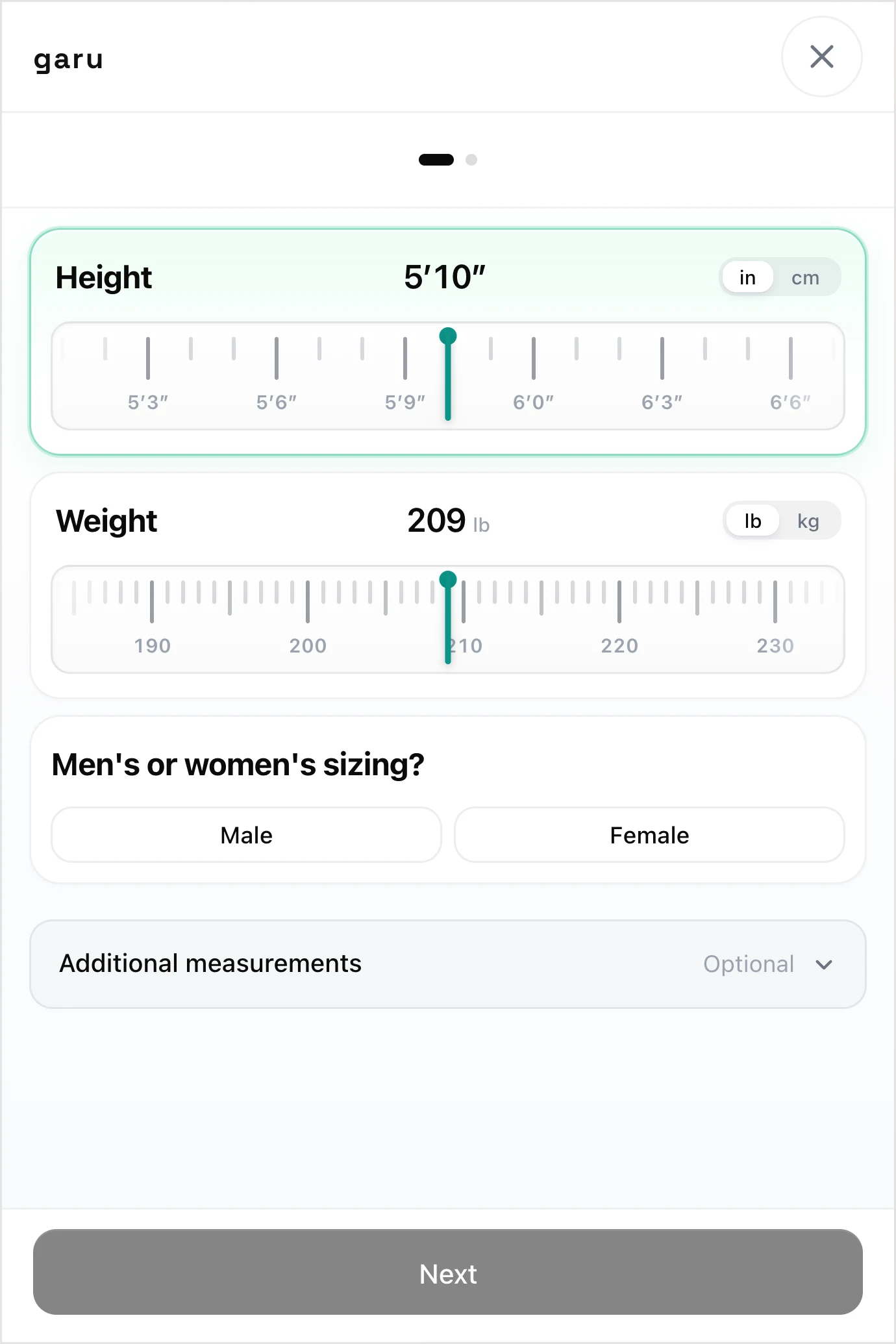
The standard size quiz asks two things, height and weight, because they are the two numbers everyone knows. They are also the two numbers that tell you the least about whether a shirt will close across the chest.
Two shoppers, same height, same weight, different sizes
A 5′10″, 170 lb runner and a 5′10″, 170 lb rugby player do not wear the same jacket. One carries weight in the legs, the other across the shoulders and chest. A height-and-weight model has to pick one of them to be wrong about, and it usually splits the difference and is slightly wrong about both.
Garments don’t care about weight. A shirt fits or doesn’t at the chest and the shoulder. Trousers fit or don’t at the waist, the hip and the inseam. Those are girth and length measurements, and they are what every size chart is written in.
What we changed in Garu
Garu’s recommendation is driven by girth first. Chest, waist and inseam carry the decision; height and body shape refine it; weight is used only as a prior when nothing better is known. When a shopper gives us their measurements, the chart match is direct, and the fit note can be specific: snug through the chest, relaxed through the body, longer at the hem.
- Tops are decided at chest and shoulder.
- Trousers and denim at waist, hip and inseam.
- Dresses at bust, waist and hip, with length as the note.
- Bras at band and cup, with the band feel as the note.
Why this is the number that moves returns
Roughly 42% of fashion returns are size-related. Those returns are not shoppers who misjudged their weight. They are shoppers who ordered by a label and found the chest tight or the rise short. A recommendation that reasons in the garment’s own terms addresses the return where it happens.
The practical test for any sizing tool is simple. Give it two profiles with the same height and weight and different chests. If it returns the same size with the same confidence, it isn’t measuring, it’s averaging.